








Compare Fibre Broadband Deals

Save money on a fast, full fibre broadband deal

  • Can't find your address? Search by postcode

Best deals of October 2026

compared, last updated

Providers

The company you buy broadband from

Infrastructure

The technology your provider uses

Download Speed (Mbps)

Upload Speed (Mbps)

Monthly Cost (£)

Upfront Cost (£)

Contract Length (Months)

Reset filters

150 Mbps Fibre Broadband

Community Fibre
  • 150 Mbps

    avg. download speed

  • 150 Mbps

    avg. upload speed

  • WiFi 6

    Router

  • £15.00*
    per month
  • £0.00 upfront
  • 24 month contract
View Deal

*Monthly cost increases to £18.00 per month in April 2027 and £21.00 per month in April 2028.

Full Fibre 300

Plusnet
  • 300 Mbps

    avg. download speed

  • 50 Mbps

    avg. upload speed

  • WiFi 5

    Router

  • £23.99*
    per month
  • £9.99 upfront
  • 24 month contract
View Deal

*Monthly cost increases to £27.99 per month in April 2027 and £31.99 per month in April 2028.

Bonus: £150 Reward Card

You1000

YouFibre
  • 900 Mbps

    avg. download speed

  • 900 Mbps

    avg. upload speed

  • WiFi 7

    Router

  • £24.00
    per month
  • £0.00 upfront
  • 24 month contract
View Deal

Full Fibre 900

BT
  • 900 Mbps

    avg. download speed

  • 110 Mbps

    avg. upload speed

  • WiFi 6

    Router

  • £32.99*
    per month
  • £0.00 upfront
  • 24 month contract
View Deal

*Monthly cost increases to £36.99 per month in April 2027 and £40.99 per month in April 2028.

Bonus: £175 Reward Card

Gig1

Virgin Media
  • 1130 Mbps

    avg. download speed

  • 104 Mbps

    avg. upload speed

  • WiFi 6

    Router

  • £29.99*
    per month
  • £0.00 upfront
  • 24 month contract
View Deal

*Monthly cost increases to £33.99 per month in April 2027 and £37.99 per month in April 2028.

150 Mbps

Rise Fibre
  • 150 Mbps

    avg. download speed

  • 20 Mbps

    avg. upload speed

  • WiFi 6

    Router

  • £17.99*
    per month
  • £0.00 upfront
  • 24 month contract
View Deal

*Monthly cost increases to £27.99 per month in March 2027 and £31.99 per month in March 2028.

Bonus: £10 discount for the first 4 months

500 Mbps Fibre Broadband

Community Fibre
  • 500 Mbps

    avg. download speed

  • 500 Mbps

    avg. upload speed

  • WiFi 6

    Router

  • £16.00*
    per month
  • £0.00 upfront
  • 24 month contract
View Deal

*Monthly cost increases to £19.00 per month in April 2027 and £22.00 per month in April 2028.

Explorer 300

Gigaclear
  • 300 Mbps

    avg. download speed

  • 300 Mbps

    avg. upload speed

  • WiFi 7

    Router

  • £19.00*
    per month
  • £30.00 upfront
  • 18 month contract
View Deal

*Prices may change during the contract

200 Mbps

Zzoomm
  • 200 Mbps

    avg. download speed

  • 200 Mbps

    avg. upload speed

  • WiFi 6

    Router

  • £20.00*
    per month
  • £0.00 upfront
  • 24 month contract
View Deal

*Monthly cost increases to £24.00 per month in November 2027.

1 Gbps Fibre Broadband

Community Fibre
  • 1000 Mbps

    avg. download speed

  • 1000 Mbps

    avg. upload speed

  • WiFi 7

    Router

  • £20.00*
    per month
  • £0.00 upfront
  • 24 month contract
View Deal

*Monthly cost increases to £23.00 per month in April 2027 and £26.00 per month in April 2028.

About these results

  • CompareBroadband.com is a price comparison website. We display broadband deals from broadband providers across the UK, and allow you to compare tariffs based on factors such as their pricing, speeds, technology type, and more. To purchase a broadband plan, click "View Deal" and complete the transaction on the provider's website.
  • Displayed prices assume that payment is made via direct debit. Some providers may charge higher costs when payment is made using other methods.
  • Some broadband providers have mid-contract price rises, meaning the monthly cost on a given tariff can increase at certain intervals during the contract period by a specific predetermined amount. When a mid-contract price rise is in place, this is shown on our website at the bottom of each deal card.
  • In the filters shown next to the comparison results, a "Provider" is a company that you buy broadband from. Each Provider uses one or more types of "Infrastructure", which is an underlying broadband network used to deliver internet service. For example, BT and Plusnet both use the Openreach network. Using our website, it is possible to filter tariffs based on Provider or the underlying Infrastructure that they are using.
  • The default "Popular" sort method sorts deals based on the lowest monthly cost, but with certain popular and/or sponsored deals interspersed in the rankings based on manual placement at our editorial team's discretion. These popular deals are prioritised based on our subjective assessment of their market popularity, and their price/value competitiveness compared to other deals on the market. Other sort methods are available using the drop-down menu at the top of the provider filters, including "Lowest monthly cost", "Lowest upfront cost", and "Highest download speed".
  • By default, deals are displayed with a minimum download speed of 100 Mbps. To view all deals, use the "Download Speed (Mbps)" filter next to the deals displayed. Speeds displayed are an advertised average and can vary slightly over time.
  • In some cases, prices and deals displayed are available only to those who are new customers to a given broadband provider. They cannot be taken up by existing customers re-contracting or changing their plan.
  • CompareBroadband.com has commercial relationships with broadband providers displayed on this website. When you click through to a given provider and become a paying customer of them, we may be entitled to receive a commission.
  • At times, broadband providers sponsor certain deals to display higher in the "Popular" sort ranking on our website. When a deal is sponsored, it is labelled as "Sponsored" on the deal card. Choosing a sort method other than "Popular" resets deal rankings so that sponsored listings do not receive priority placement.
  • We make every effort to ensure that prices, contract conditions, and other terms displayed on our website are always up-to-date, but we do not guarantee that all data is always completely correct. Make sure to check the full terms of a given broadband deal on the provider's website before buying.
  • Our website does not necessarily contain all broadband deals from all given providers on the market at any given moment.

How to change broadband provider

  1. 1. Compare broadband deals

    Use CompareBroadband.com to find the best broadband deals available at your address

  2. 2. Place a broadband order

    Find the right broadband plan for you, and place an order on the provider's website

  3. 3. Your new provider sorts your switch

    In most cases, your new ISP will handle everything under Ofcom's One-Touch Switching scheme, including cancelling your old connection

  4. 4. Get set up

    Your new ISP will arrange a quick engineer visit to install fibre to the home, or you'll receive a router in the mail for easy self-setup

  5. 5. Go live with better broadband

    Begin using your better broadband, with upgraded WiFi tech, faster download speeds, or lower monthly costs

FAQs

  • What is CompareBroadband.com?
    • CompareBroadband.com is a comparison website that collates data on broadband deals from major providers across the UK, allowing you to find the best plan for your needs, available at your address.
  • How do you rank broadband deals?
    • By default, broadband deals are sorted by popularity, based on deals with the lowest cost, and plans that people are often clicking on or buying. Sponsored deals can also appear higher in the rankings - these plans are labelled as "Sponsored". You can also choose to rank deals based on the lowest monthly cost, lowest upfront cost, or fastest download speed using the "Sort by" option next to the deals display.
  • How do I switch broadband provider?
    • In general, you can switch broadband provider simply by placing an order for a new broadband plan on a broadband provider's website. Once you place an order, the new provider will handle the cancellation of the old connection on your behalf under Ofcom's one-touch switching scheme. Next, your new provider will organise a time with you to send an engineer to set up your new connection if necessary, or ship you a router in the mail if self-setup is possible. On the switchover date, you'll go live with your new broadband plan, and your old service will cease, helping to prevent any downtime for your broadband connection. There is typically a 14-day cooling-off period after placing a broadband order in case you change your mind.
  • Will I have to pay any fees to leave my current broadband provider?
    • In general, you do not have to pay a fee to leave your current broadband provider as long as you are not in a fixed-term contract with them. Meaning, your initial contract period has expired (which usually occurs 12, 18, or 24 months after buying) and you have not renewed the contract, meaning you have not entered into a new fixed-term agreement with your current broadband provider. If you are in a fixed-term agreement, you usually have to pay a cancellation fee before you can leave.
  • What is the difference between broadband providers and broadband infrastructure?
    • Each broadband provider in the UK sells service delivered using a certain type of infrastructure, also known as a broadband network. For example, BT uses the Openreach network, and Sky uses both the Openreach and CityFibre networks. We allow you to filter broadband deals by provider (seller) and infrastructure (network), in case there is a particular broadband network you would like to use. But if you prefer, you can just filter deals by provider as well.
  • What broadband speed do I need?
    • The exact broadband speed you need depends on how many people use the internet at home, and what sort of activities you do online. For example, streaming high-definition videos requires more bandwidth than regular web browsing does. For one to two people, a 100 Mbps download speed should be plenty, but you might want 200-300 Mbps or more as a family with a lot of people online. To get a more exact idea of what download and upload speed it's worth paying for, given how your household uses the internet, use our internet speed needs calculator.
  • How do mid-contract price rises work?
    • Some broadband providers increase the monthly cost of their plans during the contract period. Usually, the price rise is laid out in pounds and pence when buying a given broadband deal, so you know how the cost will change during the contract period before you commit. If the increase is not laid out ahead of time, and the provider changes their pricing mid-contract, you can generally leave the agreement without paying an early termination fee. Usually, price rises take place annually, often each April, meaning if you buy a 24 month contract, there will generally be two mid-contract price rises to plan around. In saying this though, some broadband providers, often smaller ones, offer tariffs with no mid-contract price increases.
  • Which broadband providers can I use at my address?
    • There are now dozens of different broadband networks and hundreds of different providers serving different parts of the UK. To find out which options are available at your address, type in your postcode at the top of the page, select your address, and browse the different deals available.
  • How can I save as much money as possible when buying?
    • To save money when buying broadband, we recommend avoiding add-ons such as inclusive landline calling minutes, WiFi extenders, and pay-TV services if you don't really need them. Also, avoid paying for more bandwidth than you need, and make sure to use CompareBroadband.com to view the different deals available at your address before committing to a given provider. It can also be worth considering 5G internet services instead of using fibre broadband to save money, and you may also be able to get a cheaper, discounted broadband deal using a social tariff if you are receiving certain types of benefit payments at the moment.
  • What is the difference between FTTC and FTTP broadband?
    • Most modern broadband plans are delivered using fibre-optic cable, which is laid underground from the local broadband exchange. Fibre is either laid just to the cabinet in your street (fibre to the cabinet, also known as FTTC), with copper bridging the gap from the cabinet to your property, or more commonly, fibre is laid all the way to your house (fibre to the premises, also known as FTTP). While FTTC typically offers maximum download speeds of up to 100 Mbps in most cases, FTTP normally offers 1,000 Mbps or even sometimes up to 10,000 Mbps (10 Gbps).
  • What is 4G/5G internet?
    • Rather than using fixed cables in your street, some broadband providers use wireless internet technology to connect to the internet, just like your phone does. These plans still come with a WiFi router that creates a hotspot you can use to get online, but rather than plugging into a wall socket, the router comes with a SIM card, and connects to the mobile network. Wireless internet plans can be cheaper than fibre broadband, but it's important that you have good mobile network signal in your area to ensure you get good speeds when using this technology. This is why many 4G/5G internet plans come with more generous return policies, allowing you to test the speeds at your house before committing to the length of the contract.

What speeds can I get with fibre broadband?

The exact speeds you can get with fibre broadband depend on the broadband networks available at your address.

You can check which networks and providers are available where you are using the postcode checker at the top of this page.

In general, most full fibre broadband networks offer a maximum download speed of around 1,000 to 2,000 Mbps. This includes Openreach (up to 1.6 Gbps, or 900 Mbps with some providers) and Virgin Media (up to 1,130 Mbps in some areas, 2,000 Mbps in others).

However, some newer altnet providers offer faster speeds than this. Community Fibre offers up to 5,000 Mbps in the areas of Greater London they service, as does Sky Broadband if they are using the CityFibre network in your area.

YouFibre, which uses the Netomnia network, offers download and upload speeds of up to 7,000 Mbps.

Symmetrical downloads and uploads, explained

Usually, when using fibre broadband, your upload speeds are slower than your downloads.

For example, a plan with a 300 Mbps download speed might come with a 50 Mbps upload speed.

However, some broadband networks offer symmetrical download and upload speeds, meaning your uploads match your downloads.

For most households, this isn’t necessarily worth paying more for, since most of us download a lot more data than we upload.

But if you often perform large file uploads, having symmetrical speeds can be quite convenient.

The fibre broadband installation process

If you are joining a given fibre network for the first time, or upgrading to full fibre from part fibre, you will need to have an engineer visit to get you set up.

When you place a broadband order, or shortly after, you’ll be invited to specify a time slot that works for the appointment.

Typically, you’ll be able to specify whether you will be free in the morning or afternoon on a specific day. The technician will normally send you a text later on when they have a more specific idea of when they will arrive.

In most cases, the engineer’s job is to connect the last bit of fibre from the street to your house. Most of the time, they will use existing ducting to achieve this.

They may also install a new internal modem inside your house, which is what your router plugs into, and they’ll normally set up the router and test that everything is working as well.
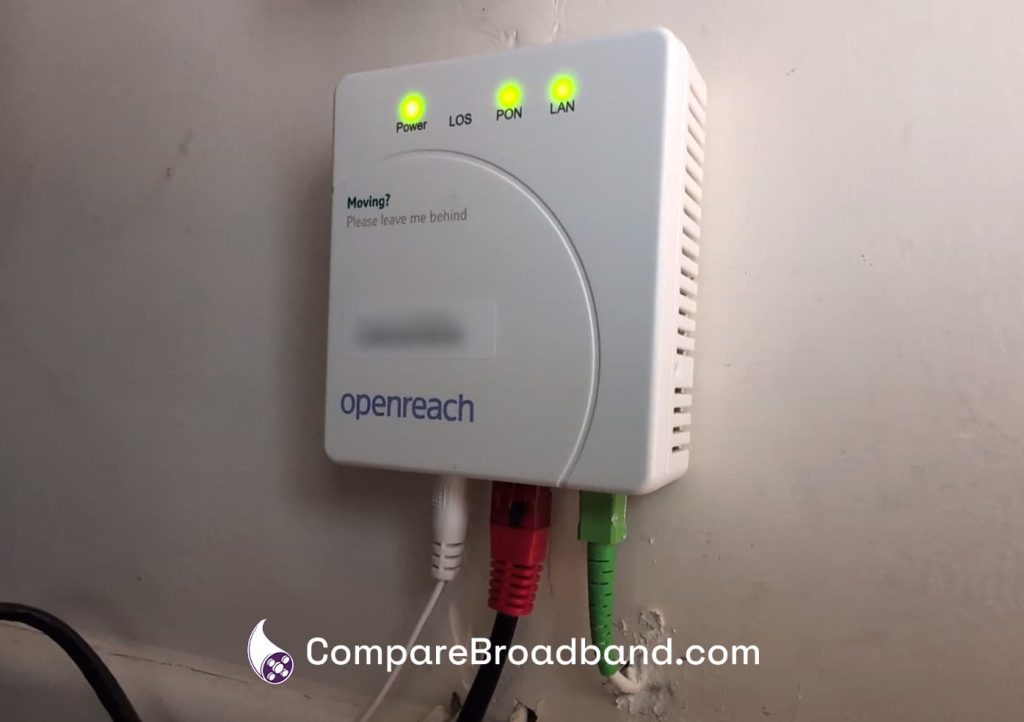
Openreach ONT box installed on wall.
Openreach ONT box (modem).

However, if you are switching between broadband providers on the same fibre network, such as from Plusnet’s 300 Mbps plan to EE’s 900 Mbps deal, which are both on the Openreach network, then an engineer visit isn’t usually necessary.

In this case, you’ll receive your new router in the mail a few days before the switchover date, with instructions to set it up yourself when you’re ready.

FTTC vs FTTP broadband

Fibre to the cabinet (FTTC) broadband is an older type of technology where fibre is only installed to the broadband cabinet in your street.

From the cabinet to your house, copper cabling is used, and as a result, FTTC broadband is usually limited to a download speed of less than 100 Mbps.

Fibre to the premises (FTTP) broadband is what most of the UK now has access to. With FTTP, fibre is laid all the way from the exchange to your house, resulting in the fastest possible download and upload speeds.

If FTTP is available, most providers won’t sell you FTTC broadband, so you don’t normally need to worry about accidentally buying this type of outdated tech.

Just make sure to put in your postcode at the top of this page to find all of the FTTP broadband providers available in your area, to ensure you get the best possible performance.

Does Virgin Media offer fibre broadband?

Virgin Media has historically only offered something called hybrid fibre coaxial (HFC) technology, not full fibre broadband.

This type of cabling offered similar performance to full fibre, just with slightly lower upload speeds.

However, Virgin has been upgrading its network in recent times, and now offers full fibre in many parts of its network.

In some of these areas, they now also offer symmetrical download and upload speeds, though you often have to pay more to get the faster uploads added to your plan.

Fibre broadband vs 5G internet

As well as fibre broadband, 5G technology has been increasingly deployed around the UK in recent years, and many are now using it as their main way of getting online at home.

5G is not as fast as fibre, and its latency is not as low. It usually tops out at a maximum download speed of around 300-400 Mbps.

However, 5G routers are very easy to set up, and no engineer visit is needed to go live.

5G internet can also be cheaper than fibre, and more flexible, since you can pick up the router and use it anywhere in the UK with good mobile signal.

Essentially, 5G broadband can be a cheaper, simpler alternative to fibre in some cases, but its overall performance is not quite as good.

Superfast vs ultrafast fibre

The term “superfast” is usually used to refer to fibre broadband plans with a download speed of 30 to 300 Mbps.

On the other hand, ultrafast fibre refers to a plan with a 300 Mbps or greater download speed.

This is purely a marketing term, and does not have any other meaning related to the quality of your connection, other than the speed you will receive.

How to save money on fibre broadband

If you want to save money on your broadband bill when switching fibre providers, here are some ways you can do this:

  • Only get a plan with the broadband speed you really need. Once you go above a download speed of about 1,000 Mbps, monthly costs can increase significantly. You can use our speed needs calculator to get an idea of what it’s actually worth paying for.
  • Avoid add-ons such as WiFi guarantees, TV channels, or inclusive home phone minutes bundles if possible. Try to buy WiFi extenders separately if needed to help save money over time.
  • If you have a pay monthly phone contract with a company such as Vodafone, consider switching your broadband to them as well. The major mobile networks that sell fibre sometimes offer discounts on their broadband deals for existing mobile customers.
  • Ensure to put in your postcode at the top of this page to find the cheapest providers in your area, and ensure you’re not missing out on any altnets that could offer a better deal than the major providers.
  • Consider using 5G internet instead of fibre broadband, if it would work for your needs.